
Forests are Not Just Carbon, and Climate is Not Just Emissions
Oct 30, 2025
By Hart Hagan
Member of the EcoRestoration Alliance
Issues addressed herein:
What does the mainstream climate movement say about climate change? And what is missing from that narrative?
How do forests provide the infrastructure for our water cycles?
How do both water and carbon flow into a living system?
How do both water and carbon flow out of a dying system?
How do forests make clouds?
What caused the death of over 100 howler monkeys in Mexico?
Do fossil fuels cause drought?
It should go without saying that forests are not just carbon. But it doesn’t. The mainstream climate movement has decided to focus on carbon dioxide almost exclusively as a solution to climate change and climate change almost exclusively as the premier threat of our time.
What gets left out of the picture? Forests as habitat. And forests as cooling mechanisms for the local climate, the regional climate and — some would say — the global climate, and not just because they have the power to draw down carbon, but because they have the power to manage our water resources.
Cloud formation
Forests cool the climate by driving cloud formation, because clouds are condensed water and the evaporating water from a forest contains bacteria and organic molecules that cause condensation. These clouds not only block the rays of the sun, but provide natural, gentle, consistent rainfall.
Evaporation
Forests cool the climate, locally and otherwise, by causing evaporation. After a rain, water will evaporate from wherever it fell, including a parking lot or bare dirt. But a forest soaks up more rainfall (preventing flooding) and then channels that water up through the tree trunks and out through the branches and leaves, whereupon it evaporates. This evaporation causes a cooling effect.
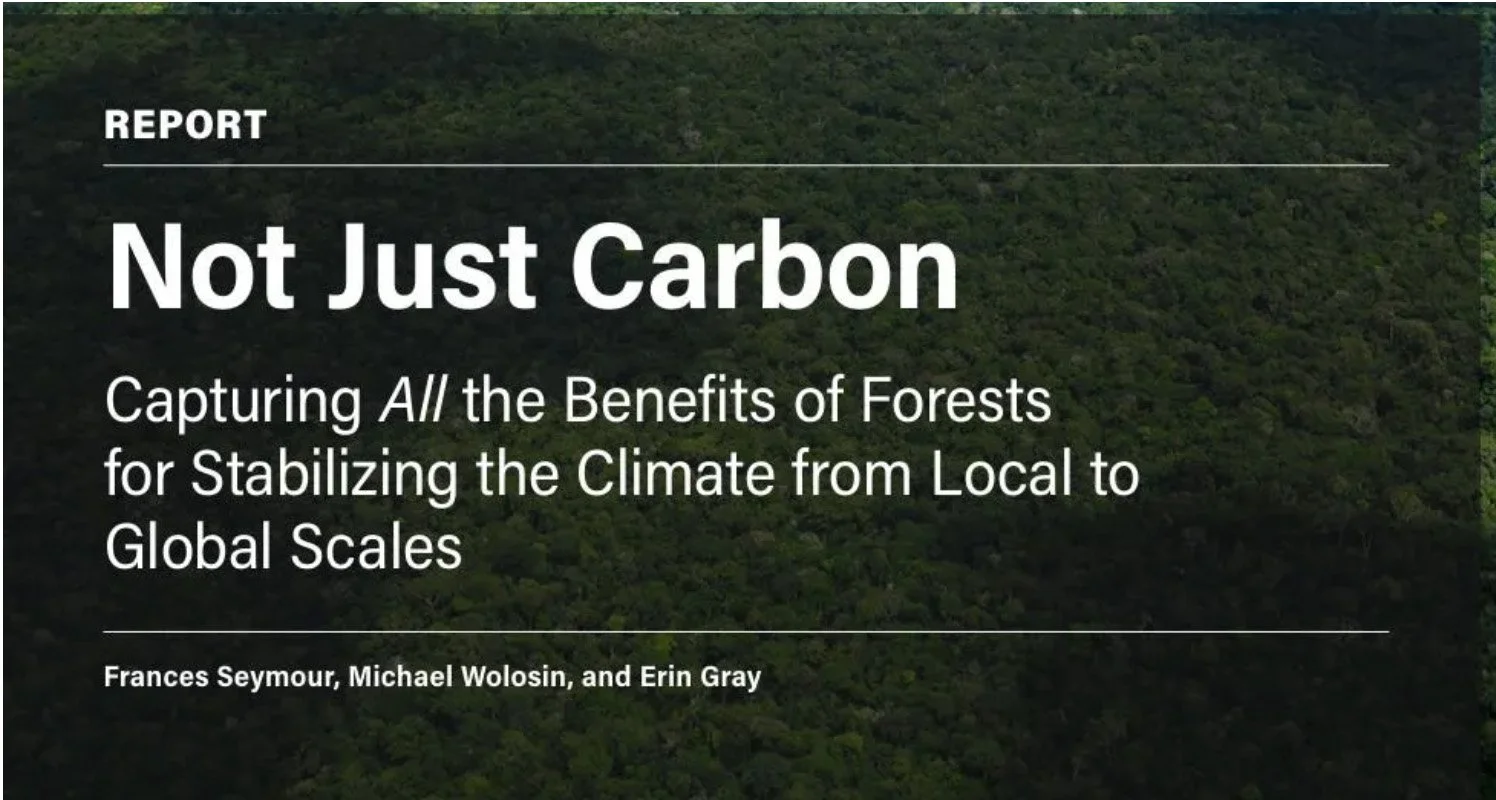
“In the same way that your body feels cooler after a swim as water dries off your skin, evaporation and transpiration also carry heat away from leaves and forest surfaces, leaving the surface and near-surface atmosphere cooler.” not-just-carbon.pdf
Absorbing carbon and water at the same time
Forests manage heat by absorbing carbon, but also by absorbing water. They take carbon out of the atmosphere via photosynthesis. Photosynthesis builds organic molecules like sugars and starches that make tissues like lignin and cellulose that make roots, trunks, branches and leaves.
All the while, throughout this process, water is flowing into the plants, and into the forest ecosystem.
A forest is half water
Water is about half of a forest, because plants are about half water, on average.
So, a forest is not just carbon. It’s largely water. Water and carbon flow together, into living systems and out of dying systems.
Degrading the forest releases water
As long as the living system is growing, then water and carbon flow into it, because living things are made largely of water and carbon. But when you degrade that living system, e.g., via deforestation, then water and carbon flow out of that system.
When you cut down trees on an industrial scale, most of that carbon goes into the atmosphere as the sawdust and the slash debris decompose. Also, water evaporates from the sawdust and the slash debris.
Deforestation removes the carbon sink
So when you cut down a forest, you are destroying the ability of this living system to remove carbon from the atmosphere, but also you are compromising the ability of this living system to manage water.
Lessons from howler monkeys
Last year, we heard the news that over 100 howler monkeys in Mexico had died amid a record heatwave, with temperatures soaring over 100°F.
Most media outlets followed along with the narrative that says these monkeys died from “climate change.”
What is climate change?
Okay. But what is climate change, and what causes it? The mainstream narrative is that climate change is the result of fossil fuels, which emit carbon dioxide, which causes warming, which causes heat waves, drought and the death of monkeys.
But fossil fuels do not cause deforestation. They enable deforestation, because fossil fuels build and run the heavy equipment that has replaced axes and chain saws in the process of deforestation.
The simplistic view of climate change makes fossil fuels the “hero” of the plot ignores water cycles and the effects of deforestation on those water cycles.
The New York Times reported that the affected howler monkeys
“… eat fruit and leaves, which are also one of their main sources of water. Scientists suspect that the drought dried up leaves and streams, making it harder for the monkeys to hydrate.”
What causes drought?
And then the question is, what caused the drought? I’m going to go out on a limb (metaphorically speaking) and say that deforestation is a major cause of drought, which causes water scarcity, which causes monkeys to die of thirst. Thirst and dehydration are at least part of the cause of monkey deaths, possibly the major cause. And deforestation is a least partly the cause of drought, possibly the major cause.
For more, I invite you to attend this free webinar.
RSVP: Forests are Not Just Carbon. Tuesday, November 4 at 7:00 PM (Eastern Time)
+
Read more of our blog posts on Medium